 Nexus
NexusGuides → Best help desk wallboards in 2026
Best help desk wallboards in 2026
A "best of" list is only useful if it tells you who each tool is wrong for, too. We build a wallboard (Nexus), so treat this as a partial source — but we've tried to be fair about where the others genuinely win. Here's an honest look at the leading help desk wallboards in 2026 and who each one actually suits.
What makes a good help desk wallboard
Before the list, the criteria that actually matter when a screen has to live on a wall all day:
- Truly live — seconds, not minutes. A queue that updates every 10 minutes isn't a wallboard.
- Wall ergonomics — 4K scaling, rotation, kiosk/lock mode, readable from across the room.
- Help desk depth — SLAs, CSAT, call queues, not just generic charts.
- Predictable cost — flat pricing beats per-dashboard or per-seat creep.
- Data ownership — does your customer data leave your network to render the board?
1. Nexus — best for self-hosted, help-desk-deep teams
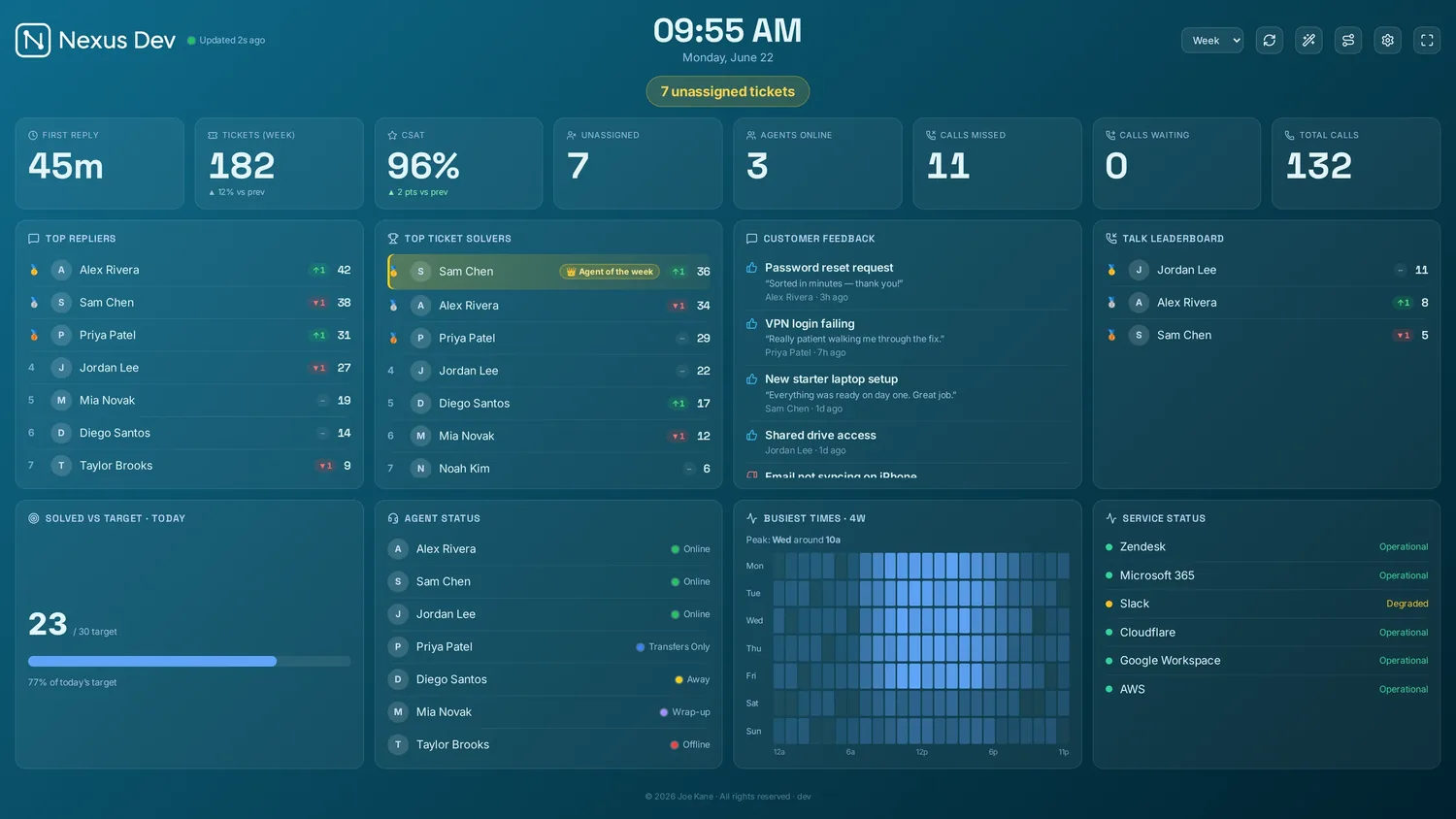
Nexus is a self-hosted wallboard that reads Zendesk (Support + Talk), Freshdesk, Freshservice, Jira Service Management, HaloPSA, SuperOps, NinjaOne, ConnectWise, Zoho Desk, Help Scout and Front directly. It runs on your own machine or Docker, so ticket data never leaves your network, and it's flat-priced (£29–£119/mo) with unlimited screens and agents. Best for: teams that want help-desk-deep panels, data ownership and predictable cost. Not for: teams needing 90+ generic cloud connectors on one screen. See the Zendesk, Freshdesk and HaloPSA guides.
2. Geckoboard — best for breadth of cloud sources
A polished, mature cloud dashboard with a huge connector library — Salesforce, HubSpot, Sheets and many more alongside your help desk. Best for: putting many cloud sources on one screen. Trade-offs: your data is processed in their cloud, and pricing climbs by dashboards and users. (Full Nexus vs Geckoboard comparison.)
3. Plecto — best for contest-style gamification
Plecto's strength is deep, motivating gamification — contests, achievements, leaderboards — pulling from many sources. Best for: sales-and-support floors that live for competition. Trade-offs: per-seat pricing with minimums, cloud-hosted. (Full Nexus vs Plecto comparison.)
4. Zendesk Explore — best for historical BI inside Zendesk
If you're on Zendesk and need custom queries, datasets and joins, Explore is excellent — but it's built for analysts at desks, not a live TV. Best for: month-end reporting. Trade-offs: limited live/TV ergonomics; most teams pair it with a dedicated wallboard. (Full Nexus vs Zendesk Explore comparison.)
5. Grafana — best for engineering-led, DIY teams
Open-source, free to self-run, and superb for metrics and observability — if you have engineers to wire data sources and build panels. Best for: technical teams who want total control. Trade-offs: no help desk depth out of the box; you build every query and kiosk view yourself.
How to choose
Short version: if you need many cloud sources on one screen, look at Geckoboard. If you want contest gamification, Plecto. If you need deep historical reporting inside Zendesk, Explore. If you have engineers and want DIY control, Grafana. If you want a help-desk-deep, self-hosted, flat-priced wall that works today, Nexus. The honest test is to put your own data on each one for an afternoon — see our side-by-side comparison to narrow it down first.
Prices and positioning reflect each vendor's published information as at June 2026 and change often — check each vendor's site before deciding.
Try one in 30 seconds
Nexus has a zero-setup demo — realistic sample data, no account, no card. The fastest way to see whether a help-desk-deep wall fits your team. Every plan then starts with a 14-day free trial, billed only if you keep it.