 Nexus
NexusFeatures → HaloPSA wallboard
HaloPSA wallboardThe self-hosted HaloPSA wallboard.
Built for the MSP service desk: put your live HaloPSA queue and per-client status on the wall — with RMM and monitoring panels right alongside. Nexus reads HaloPSA directly, runs on your own server, and costs a flat £29–£119/month.
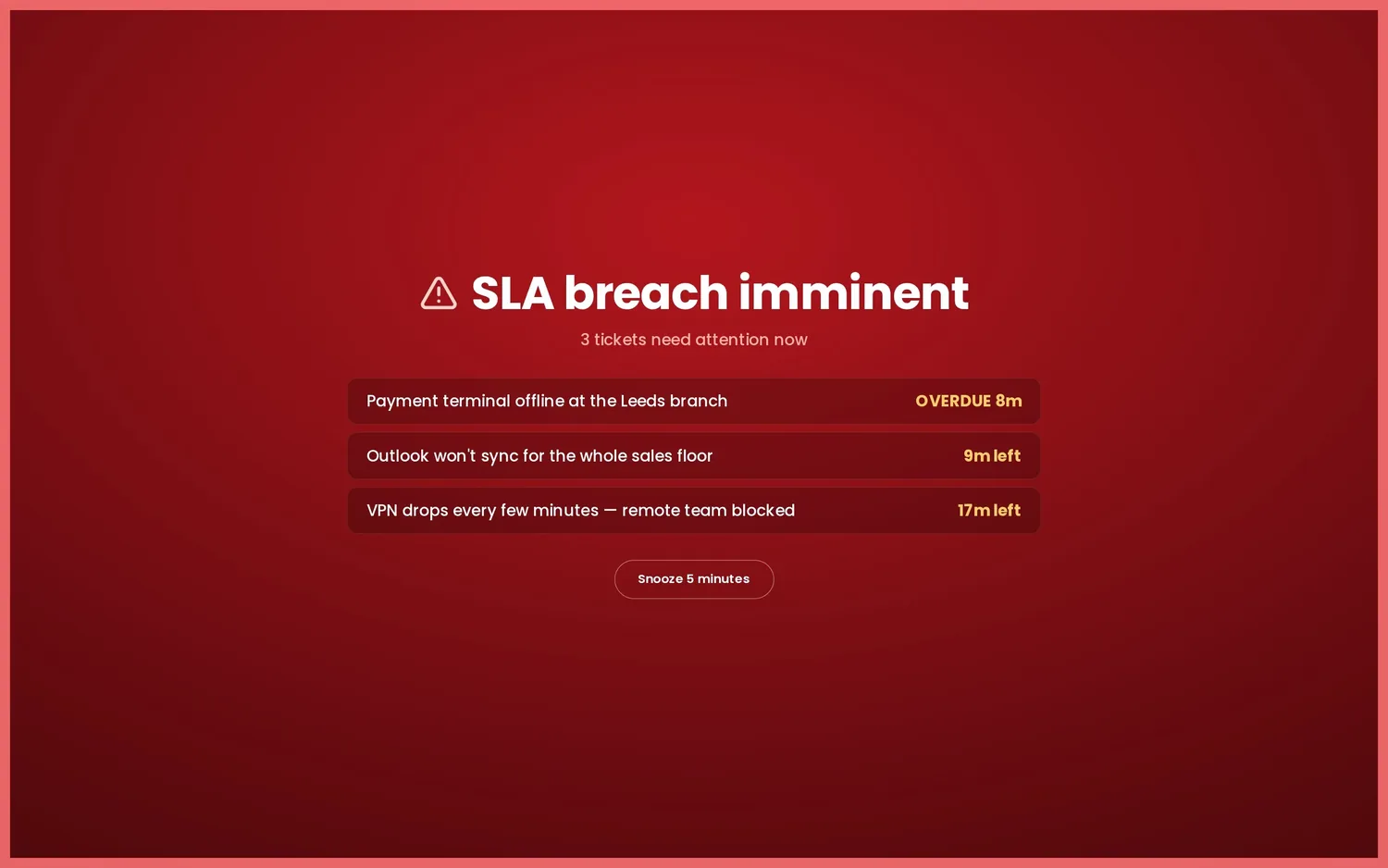
What your HaloPSA board shows.
Tickets & SLAs
Open, in-progress and breaching tickets across teams, with Halo SLA countdowns that turn amber then red before they breach. Calls logged via Teams arrive in Halo as tickets, so they're counted here too — no separate call queue to wire up.
Per-client status
Halo's clients panel, broken out by client — ticket load and status per account, the view MSPs actually run the floor on, in one glance.
Monitoring alongside
Add an RMM, network, backup and security panel next to the queue — UniFi, SuperOps, NinjaOne, N-able, Datto and more — each normalised to {name, issues, status}.
Connect HaloPSA in three steps.
- Install Nexus
Run the desktop app or the Docker server on hardware you already own. Nothing proxies through our cloud — there isn't one.
- Add a Halo API application
In HaloPSA, create an API application to get a Client ID and Client secret. Paste those plus your Halo URL —
https://yourco.halopsa.com— into the first-run wizard. On hosted multi-tenant Halo, add your tenant too; single-tenant installs leave it blank. - Add monitoring & cast
Wire up your RMM and monitoring panels, pick a theme, and send the board to the office TV. Nexus reads Halo directly; your client data never leaves your server.
Full walkthrough in the documentation.
Your client data stays yours
Nexus talks to the Halo REST API from your server. Client and ticket data never lands in someone else's cloud — there's no middleman to trust.
Flat pricing for MSPs
£29–£119/month flat — unlimited screens, agents and clients. Onboard another customer and the wall costs the same; no per-seat climb.
PSA + RMM on one wall
Halo tickets and device health side by side — the single board an MSP NOC actually needs, scaled for 4K and themed for the room.
HaloPSA wallboard FAQ.
What does Nexus read from HaloPSA?
Nexus reads tickets and their SLAs, your agents, and per-client status through the Halo REST API, then puts them on the wall with live SLA countdowns. Teams-logged calls already land in Halo as tickets, so they show up in your ticket counts rather than a separate call queue.
What credentials does the HaloPSA connection need?
Your Halo URL (for example https://yourco.halopsa.com) plus an API application Client ID and Client secret, created in HaloPSA under Configuration. If you run hosted multi-tenant Halo, you can also supply a tenant; on a standard single-tenant install you leave it blank.
Can I show RMM and monitoring next to the HaloPSA queue?
Yes. A monitoring panel runs alongside the ticket board, pulling device, network, backup and security status from vendors such as UniFi, SuperOps, NinjaOne, N-able and Datto. Every vendor normalises to per-client name, issues and status rows, so PSA and RMM share one wall.
How much does the HaloPSA wallboard cost and where does data live?
Flat £29–£119 per month with unlimited screens, agents and clients — no per-seat pricing. Nexus is self-hosted, so it runs on your own server and reads HaloPSA directly; your client and ticket data never leaves your infrastructure.
Run a different desk?
See your MSP desk on the wall.
Demo mode fills the board with realistic sample data in about 30 seconds — no account, no card. Like what you see? Plans start at £29/month flat, with a 14-day free trial — billed only if you keep it.