 Nexus
NexusGuides → Support team gamification: leaderboards that actually motivate
Support team gamification: leaderboards that actually motivate
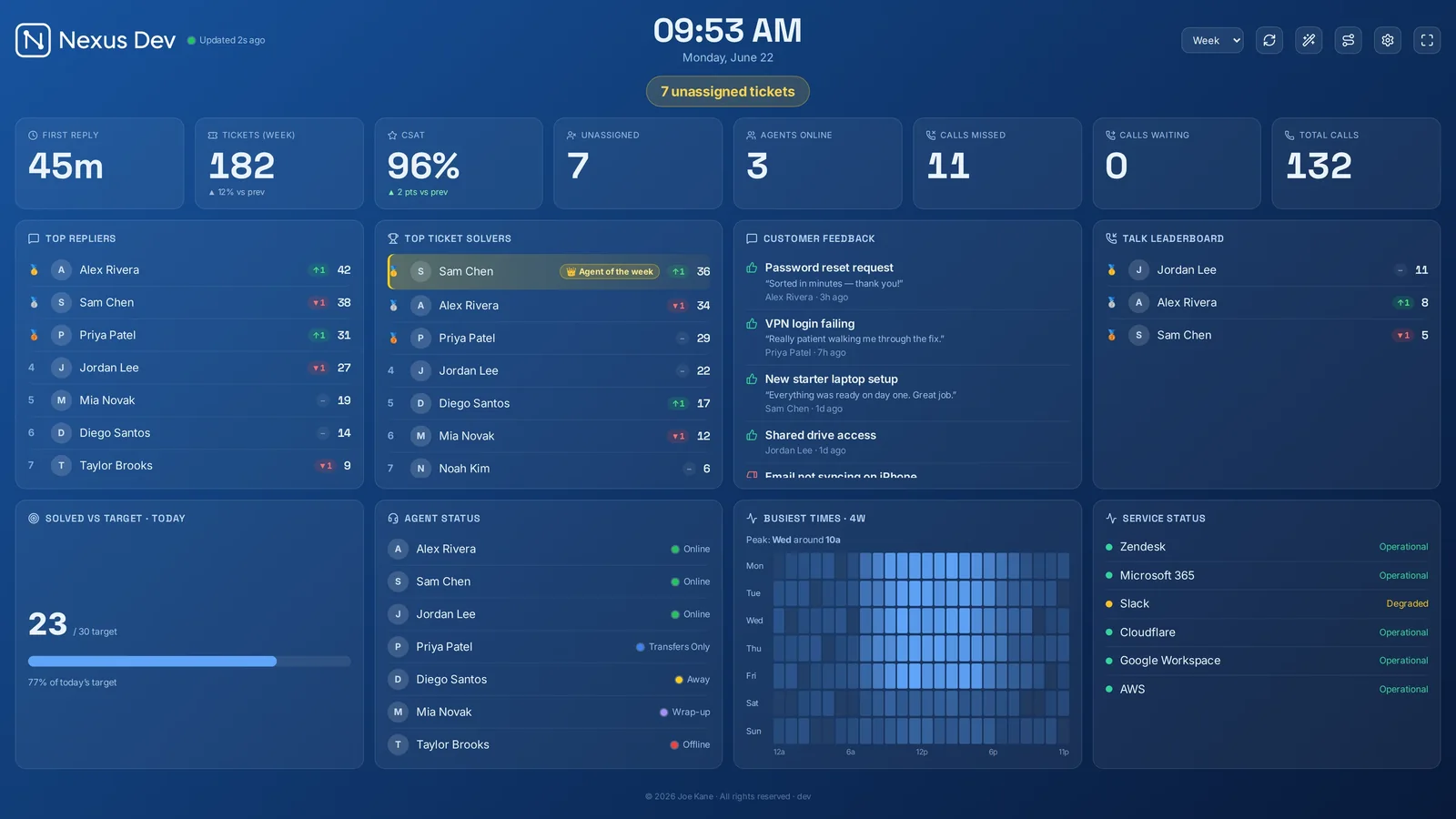
Gamification has a bad reputation in support, and usually it's deserved — a leaderboard that only counts tickets closed teaches people to close tickets badly. Done well, though, a visible scoreboard turns a quiet, individual grind into a shared effort the whole desk can see. Here's how to gamify support so it actually motivates, and where a live leaderboard on the wall fits in.
Why most support leaderboards backfire
The failure pattern is almost always the same: pick one easy-to-count number, rank everyone by it, and watch behaviour bend to the metric. Rank by tickets solved and you reward whoever grabs the quick wins and leaves the hard tickets ageing. Rank by raw speed and replies get terse, customers get bounced between agents, and reopen rates climb. The leaderboard worked exactly as designed — it just optimised for the wrong thing.
The other common failure is quieter: a leaderboard nobody can see. If the ranking lives in a report someone opens at month-end, it isn't motivating anything in the moment. Motivation comes from the score being live, visible, and tied to work people recognise as good.
Pick metrics that balance speed with quality
The fix for perverse incentives is to never let a single number stand alone. Pair every speed metric with a quality one, so the only way to climb is to be both fast and good:
- Solved, paired with CSAT. Volume tells you who's carrying load; customer satisfaction tells you whether that volume was any good. Shown side by side, a high solved count with a sagging CSAT score is obvious to everyone, including the agent.
- First response time, paired with reopen rate. Fast first replies are worth celebrating — unless tickets keep bouncing back. Watching both stops "reply fast, solve nothing" from winning.
- Contribution, not just raw totals. A part-time agent shouldn't be permanently bottom because they work fewer hours. Where you can, look at quality and consistency alongside volume so the board rewards how people work, not just how long.
A good rule: if an agent could top the board by doing something you'd quietly disapprove of, you've chosen the wrong metric. Add the counterweight.
Make the goal visible, not just the ranking
A pure ranking creates one winner and a long tail of people who can't catch them — demotivating for everyone outside the top two. Far more effective is a shared, visible target the whole team moves towards together: solved versus target today, a CSAT goal for the week, a backlog you're collectively burning down. The ranking adds friendly competition on top; the shared goal is what stops it becoming zero-sum.
Nexus puts both on the same board. The live KPI tiles and agent leaderboard sit alongside SLA breach countdowns and a solved-versus-target bar, so individual standings and the team goal are read in the same glance.
Celebrate streaks and Agent of the Week
Recognition is what makes gamification stick, and it doesn't have to mean prizes. The most reliable motivators are small, consistent, and public:
- Streaks. Consecutive days hitting a CSAT or response target. Streaks reward consistency rather than one heroic afternoon, and people genuinely don't want to break them.
- Agent of the Week. A rotating, visible spotlight does more for morale than a quarterly bonus, partly because it rotates — newer or quieter agents get their moment too, not just the same top performer every time.
- Leaderboards with streaks built in. Nexus tracks streaks and surfaces an Agent of the Week automatically, so recognition happens without a manager remembering to hand it out.
Keep the cadence frequent. Weekly recognition beats monthly, because the feedback loop is tight enough that today's effort visibly counts.
Watch for burnout. A leaderboard that runs hot all day, every day, stops being a game and becomes pressure. Rank on quality as much as speed, celebrate the team goal rather than only the individual at the top, and never use the board to single out the person at the bottom. Gamification motivates when it feels like recognition; it corrodes when it feels like surveillance.
Why a live leaderboard on the wall changes things
A scoreboard buried in a dashboard tab is something people check. A scoreboard on a screen on the wall is something people feel. When CSAT, streaks and Agent of the Week update in real time on a TV the whole team can see, recognition is ambient — you don't have to announce a good week, everyone already watched it happen. That visibility is most of the motivation.
This is the angle worth weighing if you're looking at a dedicated gamification tool. Platforms built purely for sales-style scoreboards can be powerful, but they're another subscription, another data pipeline, and often priced per seat. Our Plecto alternative page walks through the trade-offs: Nexus folds the leaderboard into the same self-hosted board that already shows your queue, SLA countdowns and monitoring, rather than bolting gamification on as a separate paid layer.
Set it up without overthinking it
You don't need to design the perfect scheme before you start. A solid first board is a KPI strip across the top, the live queue with SLA countdowns, an agent leaderboard ranked on solved and CSAT together, and a solved-versus-target bar for the shared goal. Run it for a week, watch whether any number is pushing behaviour the wrong way, and adjust.
The quickest way to see whether a wall leaderboard suits your team is to look at one running. The zero-setup live demo shows the board with sample data — no account, no card — including the leaderboard, streaks and CSAT exactly as they'd appear on your screen. If it earns its place, Nexus is self-hosted and flat-priced at £29–£119 a month for unlimited screens and agents, so putting the board on every wall in the centre costs the same as putting it on one.
See it live
Nexus puts SLA countdowns, the live queue, CSAT and leaderboards on a self-hosted board — try the demo (no account, no card), then start a 14-day free trial on your own data, billed only if you keep it.